The majority of advanced Enterprise Asset Management (EAM) systems integrate maintenance management as their fundamental operational feature. EAM platforms include maintenance scheduling, work order management and preventive or predictive maintenance as fundamental components because they support complete physical asset lifecycle management from maintenance to repair.
Maintenance operations require organisations to integrate planned strategies instead of just reactive approaches. Planned maintenance activities enable companies to detect problems in advance thus preventing unexpected disruptions which results in better operational efficiency. This approach in maintenance strategies focuses on moving beyond traditional reactive maintenance practices.
Effective maintenance operations results in the highest possible operational performance of vital machinery and equipment. The combination of Mean Time Between Failure (MTBF) maximisation along with scheduled inspections produces both optimal asset performance and decreased downtime.
Smart maintenance management systems use condition monitoring technology to identify potential problems which helps prevent major issues from developing. The overall stability of assets improves through this approach. In this article we examine trends in maintenance practices through technologies and sustainability initiatives. Let’s prepare for the future of maintenance.
What is field service management?
The core functions of field service management (FSM) software are designed to streamline and optimise all aspects of managing off-site operations, such as dispatching technicians, scheduling jobs and monitoring assets. Here are the primary functions you’ll find in most modern FSM platforms:
Scheduling & Dispatch: Automates job scheduling and assigns the right worker to the right task based on availability, skills, and location.
Work Order Management: Tracks service requests and job progress, allowing for creation, assignment, monitoring, and completion of work orders in real time. Ensures comprehensive service history and accountability.
Inventory and Parts Management: Monitors inventory levels, parts usage, and tool availability, helping technicians have required materials on hand and reducing supply-related delays or errors.
Asset Management: Tracks the status, location, and maintenance history of physical assets to improve lifecycle management and reduce downtime.
Mobile Access: Technicians can access job details, update work statuses, and capture photos or signatures using mobile apps—anytime, anywhere.
Reporting and Analytics: Provides real-time dashboards and performance metrics for everything from job completion rates to technician productivity, helping managers make data-driven decisions.
Compliance and Documentation: Facilitates checklists, inspection reports, safety logs, and documentation to support regulatory compliance and quality standards.
Integration: Connects with business systems for seamless data sharing and process automation.
By consolidating these functions into one platform, EAM software enables businesses to improve efficiency, reduce admin overhead, enhance service quality, and increase both customer and employee satisfaction.
Implementing a maintenance strategy: your first line of defence
Asset management and preventive maintenance work together as essential components. Assets require maintenance checks because ignoring them will result in costly breakdowns. Preventive maintenance involves keeping resources at their peak operational condition before they reach a state of breakdown. The preventative maintenance team takes a proactive approach to schedule tasks which extend asset lifespan and minimise costs.
The implementation of a maintenance strategy becomes challenging to execute without Enterprise Asset Management (EAM) system support. EAM through maintenance management ensures that assets (such as machinery, equipment, buildings, and infrastructure) remain in good condition, allow for auditing and achieve business objectives. EAM combines technical operational and financial elements to maximise asset value while minimising costs and risks.
What are the limitations of using CMMS instead of EAM?
If you rely solely on a Computerised Maintenance Management System (CMMS) rather than a full Enterprise Asset Management (EAM) system, you may encounter several key limitations. While most EAM systems have CMMS capabilities, only the more advanced CMMS solutions have some EAM functionality.

The importance of streamlining spare parts management
An EAM system that includes maintenance management is crucial. But having spare parts and consumables tracked in the same system is invaluable. Reducing excess inventory directly reduces capital spend, lowering holding costs, and improving overall capital efficiency. For organisations that maintain their assets, tracking inventory supplies on hand is a critical function of the maintenance process.
By accurately predicting when a component is likely to fail and forecasting potential failures, maintenance teams can better manage spare parts inventory, reducing the need to keep large quantities of parts on hand “just in case”. This is where you maintenance forecasting becomes critical in reducing costs. Here are five important practices:
1. The practice of ordering parts near their actual usage time minimises storage expenses and reduces capital investment. Knowledge of approaching part lifespan enables efficient scheduling of maintenance tasks that require that specific part.
2. Historical maintenance data enables organisations to determine the expected lifespan of each asset component. The creation of precise spare parts demand forecasts results in improved stocking levels.
3. The need for spare parts during unexpected breakdowns triggers an emergency search for parts which may require expedited delivery when stock is depleted. Predictive maintenance enables planned procurement with standard delivery lead times, thereby reducing the total cost of parts.
4. Better visibility into future spare parts needs can lead to more favourable supplier contracts and a more resilient supply chain.
5. Tracking the lifecycle of parts and components based on actual usage, maintenance helps identify what is nearing replacement.
Workshop productivity through the implementation of tools management
Enhance Efficiency and Accountability with Digital Tool Management Software
The search for missing tools and the management of workshop equipment remains a constant challenge. Tools management should be considered because it provides both increased productivity levels and accountability standards. Key questions for your workshop:
- Do you have a clear understanding of which employee possesses which tool(s) and equipment?
- Can you account for everything that’s been issued?
- Do you have a system to detect unreturned items?
- Are tool calibrations, servicing, and repairs tracked and up to date?
- Is your spare parts inventory managed efficiently?
The uncertainty about any of these points makes you part of a large group. Workshops encounter these problems regularly which results in tool losses and wasted time looking of misplaced tools along with safety hazards. Managing your tools along with your machinery and equipment will allow you to:
- Monitor tool usage along with their current locations in real time
- Establish automatic alerts for tool calibration
- Track tool damage and maintenance requirements
- Enhance accountability and reduce losses
The implementation of tools management brings organisational benefits that result in operational improvements. Take control of your workshop today and experience the difference!
Unlocking cost savings and extending asset life through smarter maintenance management
The mining industry depends on machinery and equipment for its operations, so asset management best practices must be implemented to minimise downtime, reduce costs, optimise productivity and increase workplace safety. Maintenance management solutions support workplace health and safety outcomes through enforcing standards, scheduled safety check activities, condition and risk audits, and reporting as well as managing planned preventative initiatives.

A complete inventory of mining equipment serves as the essential base for effective asset management. The process requires precise documentation and monitoring of equipment specifications together with maintenance records and operational statistics. A centralised equipment database provides quick access to essential information which helps organisations make better decisions about equipment maintenance and repair and replacement.
A holistic maintenance strategy should mix scheduled preventive inspections with predictive maintenance systems. Real-time data collection via integration through sensors and AI analytics enables mining organisations to predict equipment failures before they happen. This proactive maintenance strategy reduces unexpected equipment stoppages while extending equipment lifespan and lowering emergency repair expenses.
What are the different types of maintenance strategies?
Organisations that implement these maintenance strategies in a strategic manner will achieve major improvements in machinery and equipment reliability. Reducing downtime and enhancing operational efficiency.
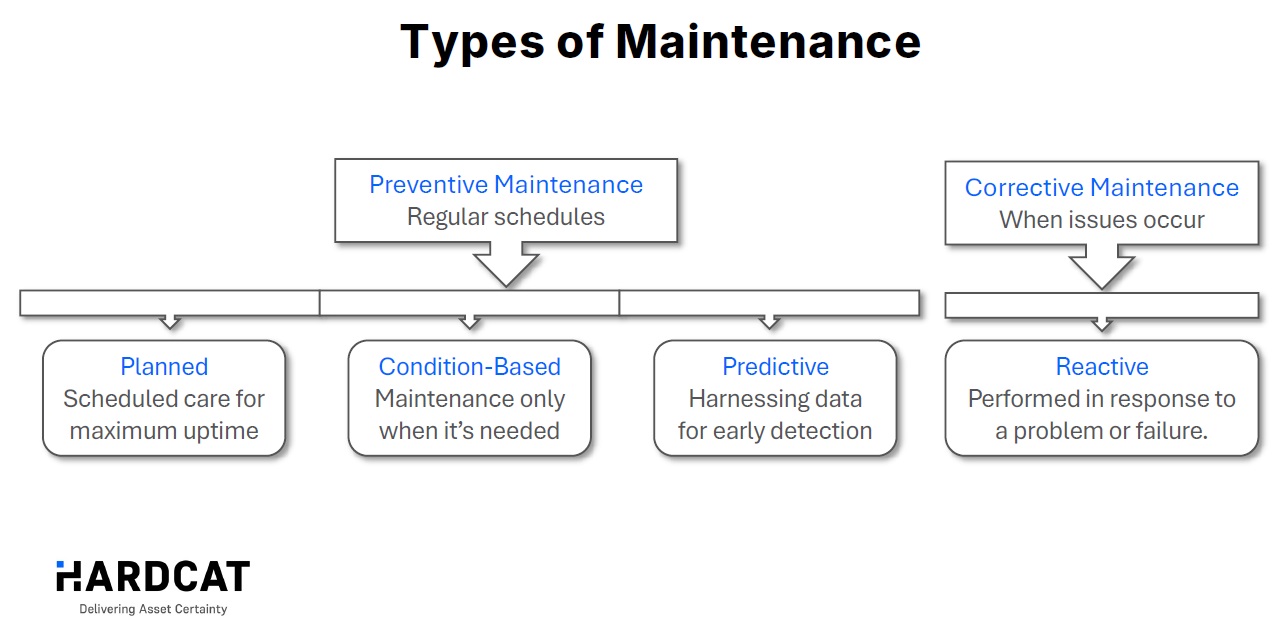
Preventive vs corrective maintenance: what’s the difference?
Planned Maintenance: Scheduled Care for Maximum Uptime
Planned (including predetermined and preventive) maintenance is a proactive, scheduled approach designed to maximise uptime, reduce major failures, and extend equipment lifespan. This strategy requires performing maintenance tasks according to a predetermined schedule which includes manufacturer recommendations and usage patterns. The approach detects potential issues at an early stage to prevent major problems from developing which reduces equipment downtime and extends its operational life.
Condition-Based Maintenance: Maintenance Only When It’s Needed
Condition-based maintenance (CBM) refers to maintenance performed when monitoring indicates that equipment performance is deteriorating or a failure is imminent. It relies on real-time data, such as vibration, temperature, or oil analysis, to determine when maintenance should be performed. This strategy involves monitoring equipment condition through sensors and other monitoring systems to perform maintenance only when necessary. This method prevents unneeded maintenance activities while optimising resource distribution and extending asset operational life.
Predictive Maintenance: Harnessing Data for Early Problem Detection
Predictive maintenance (PdM) is closely related to condition-based maintenance and is often used interchangeably. It uses data analytics, sensors, and sometimes machine learning to predict when an asset will require maintenance. Integration with sensors and real-time monitoring predict equipment failures before they happen. Through performance data analysis maintenance teams can predict upcoming problems which enables them to schedule preventive repairs before unexpected downtime occurs and optimise their maintenance resources.
Corrective Maintenance: Rapid Response When Failures Occur
Corrective maintenance is performed after a fault or failure is detected, with the goal of restoring equipment to proper working condition. This type of maintenance alone does not minimise downtime as effectively as preventive or predictive maintenance. However, a well-organised corrective maintenance process (such as having spare parts and skilled technicians ready) can help reduce the actual downtime experienced after a failure.
Reactive Maintenance: Breakdown of non-critical equipment
The maintenance approach known as breakdown maintenance and is a broader term encompassing any maintenance performed in response to a problem or failure. This strategy involves taking no action until a piece of equipment fails, essentially “running to failure”. It is typically used for non-critical equipment where downtime has minimal impact. The rationale is that the downtime or cost associated with the failure of such equipment is acceptable or less than the cost of preventive maintenance.
Reliability-Centered Maintenance: Prioritising What Matters Most
Reliability-centered maintenance (RCM) enables organisations to determine asset criticality and failure modes which helps them direct maintenance activities to the most important assets and enhance their maintenance program effectiveness. This strategy works to elevate equipment reliability and safety performance. It incorporates preventive and predictive maintenance strategies alongside corrective maintenance to achieve its goals.
What is the role of asset maintenance software in operations?
Enterprise Asset Management (EAM) systems include built-in maintenance management as a core feature to optimises the maintenance of physical assets such as machinery, vehicles and infrastructure. EAM platforms include maintenance scheduling and work order management and preventive or predictive maintenance as fundamental components because they handle the complete physical asset lifecycle from maintenance to repair.
Effective maintenance management provides an optimal return on your investment. The manufacturer recommended service regime can be pre-scheduled to automatically generate job reminders, so you never miss any maintenance on your critical assets. The maintenance manager can oversee the allocation of jobs to appropriate personnel or contractors.
Hardcat asset maintenance solutions provide tools to manage scheduled preventative and ad-hoc reactive maintenance to ensure your assets are performing well so there are no unnecessary downtime causing cost blowouts and inefficiencies. Integrating asset management software with predictive sensors, often through IoT (Internet of Things) devices, enables proactive maintenance by providing real-time insights into asset health and performance.
Key benefits for operations
Increased Equipment Uptime
Maintenance software tracks asset health and reduces unexpected breakdowns. The availability of assets remains constant because of this approach which prevents delays and costly downtime.
Improved Asset Lifespan
The software helps organisations perform necessary maintenance tasks on schedule to minimise machinery and equipment deterioration, extending investment value.
Enhanced Compliance and Safety
Documented records of all maintenance activities together with inspection results and repair work provides compliance proof. Supporting audit readiness and workplace safety by verifying assets meet necessary standards.
Cost Control and Budgeting
An EAM system tracks maintenance expenses together with spare parts consumption and workforce hours to deliver complete asset ownership cost data. Operations managers can identify cost-saving potential through the system which also enables them to make more accurate predictions about future expenses.
Data-Driven Decision Making
Asset maintenance software system collects performance data from equipment along with failure statistics and historical maintenance records. The system allows users to make educated choices about asset replacement and process enhancement and equipment upgrade decisions.
Streamlined Communication and Collaboration
The software system unifies maintenance requests with work orders and documentation which enhances communication between operations teams and maintenance staff and management personnel. The system decreases errors while providing current information to all stakeholders.
Drive asset reliability and durability with Hardcat solutions
Hardcat’s ability to become an integral part of and support an organisation’s operational processes together with regular scheduled condition and/or safety checks ensures that your regulatory and compliance obligations. The solution’s comprehensive history recording throughout asset life provides the full traceability to allow attestation, with confidence.
Scheduled and Ad-Hoc Jobs
Planned maintenance schedules ensuring the reliability as well as longevity of assets. Ad-hoc jobs can be created, as required, to respond to break/fix incidents. Regular scheduled condition and/or safety checks supports the meeting of compliance obligations.
Finding Spare Parts and Inventory
Maintenance staff are guided where jobs require specific parts. The suggested parts and their availability are presented to the maintenance worker, thereby improving quality and efficiency preparing for the execution of the work.
Mobility Application for On-site Jobs
Mobility applications can be downloaded on either dedicated specialist devices (iOS and Android), your own phone (BYOD), or on specialist, ruggedised scanning hardware. It supports both the on-line and disconnected mode, thereby enabling specific activities to be performed, even in environments where network connectivity is not available.
Qualification Checks of Personnel
Business rules are applied to ensure maintenance jobs are only allocated to appropriately qualified personnel.
Complete Asset Maintenance History
Providing complete traceability via the recording of the full history of all jobs, transactions and user interactions associated with an asset. This provides centralised reporting to support audits, risk assessments, compliance, and the claims processes.
Maintenance Jobs Status Dashboard
Providing an intuitive user interface presenting the key data that empowers the maintenance workers to effectively manage the current and forecast jobs.
Frequently Asked Questions
How do Hardcat’s EAM solutions support organisational change, workforce training, and the development of a proactive maintenance culture for successful adoption?
The Enterprise Asset Management (EAM) solutions from Hardcat aim to support successful adoption through addressing essential elements for organisational change, workforce capability and proactive maintenance culture development. Hardcat’s EAM solutions provide organisations with powerful digital tools and extensive training. Our sophisticated maintenance management features help you to achieve change success, workforce development and establish proactive data-based maintenance practices for ongoing operational excellence.
- Organisational Change: Centralised data, digital transformation, ERP integration.
- Workforce Training: Comprehensive training, user-friendly tools, role-based access.
- Proactive Maintenance: Preventive scheduling, condition monitoring, analytics, streamlined communication.
What cybersecurity and data protection measures are integrated into Hardcat’s EAM solutions, especially when leveraging IoT in industrial environments?
Every transaction, transfer, or change involving an asset is logged with a detailed audit trail. This feature supports regulatory compliance, enables forensic investigations, and ensures complete accountability for asset-related actions. This is especially important when IoT devices automate or trigger asset events. We provide robust cybersecurity and data protection, making our solutions well-suited for the demands of IoT-enabled industrial environments.
- ISO 27001 Certification: Adherence to international information security management standards.
- Data Encryption: Advanced data encryption for both data at rest and in transit, safeguarding sensitive asset and operational information from unauthorised access or interception.
- Role-Based Access Control: Restricts data access to authorised users.
- Audit Trail and Chain of Custody: Detailed logging of asset transactions for compliance and accountability.
- Secure API Integration: Hardcat provides open APIs for integration with other enterprise systems. These APIs are designed with security in mind, supporting secure data exchange between the EAM platform and external applications, including IoT platforms.
- Data Center Hosting: High-security infrastructure for cloud deployments. Hardcat EAM can be deployed on-premise or hosted in robust data centers, offering high levels of physical and network security for cloud-based deployments.
- Mobile Security: Encrypted, authenticated access for field and mobile users. The platform supports native mobile apps for iOS and Android, with encrypted communications and secure authentication to protect asset data accessed or updated in the field.
- Incident and Compliance Tracking: Integrated incident management and regulatory compliance. The system integrates incident tracking with asset management, ensuring that any security or maintenance incident is directly linked to the asset’s history and chain of custody. This is crucial for compliance, audit readiness, and rapid response to potential breaches or operational issues.
How do Hardcat’s EAM solutions ensure long-term data quality and continuous operational optimisation beyond initial implementation?
Hardcat’s EAM solutions are engineered to maintain high data quality and drive ongoing operational improvement well beyond the initial implementation phase. This is achieved through a blend of robust technical features, process standardisation, and continuous support. We provide a sustainable framework for long-term data quality and continuous operational optimisation, enabling organisations to maximise asset value, minimise downtime, and remain agile in the face of evolving business demands.
Conclusion
Strategies for maintenance management enable reliable performance while reducing operational interruptions. Teams can prevent failures and maintain smooth operations through proactive planning and data-based insights. The combination of preventive, predictive and condition-based maintenance approaches enables organisations to decrease downtime and extend the life of their assets. These strategies lead to quantifiable cost reductions and enhanced overall productivity levels.