
Estimated reading time: 8 minutes
Table of contents
Understanding and addressing Enterprise Asset Management (EAM) implementation challenges is critical to project success. EAM projects are often (but not always) launched with clear objectives. Common goals include improved asset visibility, better maintenance planning, and stronger compliance. However, achieving these outcomes requires much more than selecting software and migrating data.
“Organisations undertaking EAM initiatives should align implementation objectives with recognised asset management best practices such as those promoted by the Institute of Asset Management (IAM)”.
– The IAM is the international professional body for whole life management of physical assets
Many EAM projects fail before implementation begins because critical planning activities are overlooked. Successful EAM implementations depend on more than software selection alone. Common EAM implementation challenges include:
- Poor legacy asset data
- Unclear business requirements
- Insufficient stakeholder engagement
- Integration complexity
- Underestimating the organisational change required to support a new way of working
Successful EAM implementations begin with planning, preparation, and stakeholder alignment.
Challenges Often Begin During Software Selection
One of the most important stages of any EAM project is selecting the right solution. Organisations sometimes focus heavily on software features without first defining:
- Operational requirements
- Business objectives
- Long-term asset management goals
As a result, they may select a system that requires significant customisation, additional development, or major process changes to meet their needs.
A more effective approach is to engage key stakeholders early, including asset managers, maintenance teams, finance personnel, operational staff, and IT teams. Understanding how assets are managed today and how they should be managed in the future provides a stronger foundation for evaluating software solutions.
The most successful EAM implementations are typically supported by flexible and configurable platforms that align with organisational requirements without extensive modification.
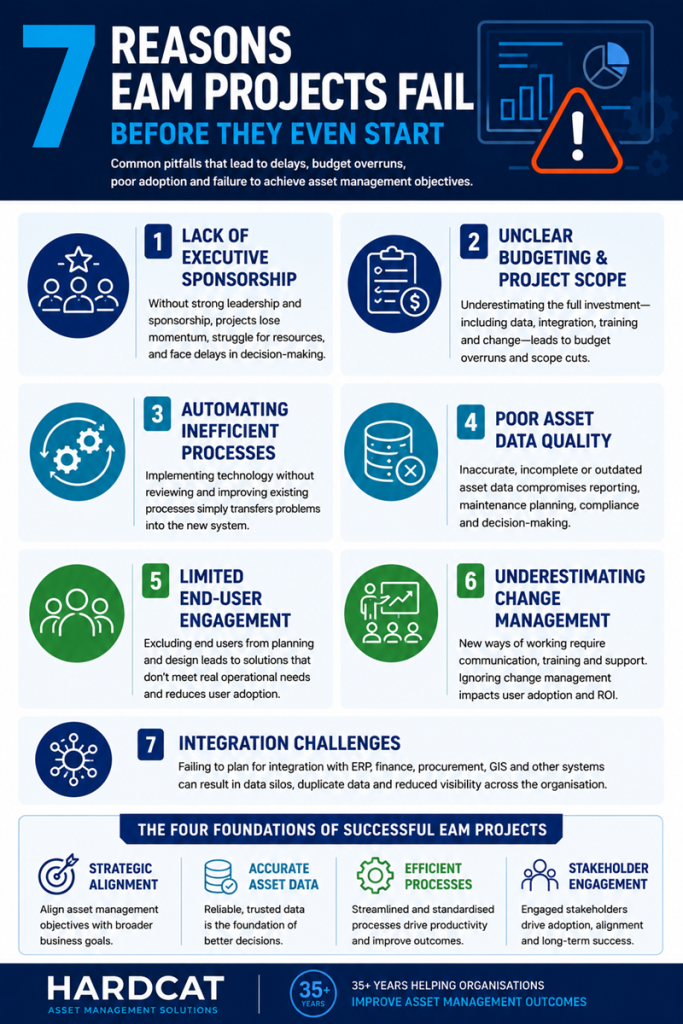
7 Reasons EAM Projects Fail Before They Even Start
While every EAM implementation is unique, many projects encounter the same challenges. The following seven factors are among the most common reasons organisations experience delays, budget overruns, poor user adoption, and difficulty achieving expected business outcomes.
1. Lack of Executive Sponsorship
EAM projects often impact multiple departments across an organisation. Asset management, maintenance, finance, procurement, compliance, and IT teams may all have different priorities and requirements.
Without strong executive sponsorship, projects can lose momentum, encounter delays in decision-making, and struggle to secure the resources required for success.
When leadership actively supports the project, it becomes easier to align stakeholders, manage competing priorities, and maintain focus on achieving measurable business outcomes.
2. Unclear Budgeting and Project Scope
Software licensing is only one component of an EAM implementation.
Data migration, integration, training, testing, change management, process improvement, and ongoing support all contribute to the overall project investment.
Organisations that underestimate these requirements may face unexpected costs, project delays, or pressure to reduce project scope after implementation has already begun.
Developing realistic budgets and clearly defining project objectives early helps minimise risk and creates a more predictable implementation pathway.
3. Automating Inefficient Processes
Technology can improve business processes, but it cannot automatically fix inefficient workflows.
Implementing a new EAM solution without reviewing how assets are currently managed can result in existing problems being transferred into a new system.
Before implementation begins, organisations should review how assets are tracked, maintained, audited, and reported on. Identifying opportunities to streamline and standardise processes can significantly improve the effectiveness of a new EAM solution and support long-term user adoption.
4. Poor Data Quality
Asset data forms the foundation of every EAM system.
If asset records and naming conventions are incomplete, inaccurate, duplicated, or outdated, the quality of reporting, maintenance planning, compliance activities, and decision-making can be compromised.
Many organisations discover data quality issues during migration projects, particularly when information has accumulated across multiple spreadsheets, databases, legacy systems, or disconnected business applications.
Conducting physical asset verification, asset audits, data capture exercises, asset register reviews, and data cleansing activities before implementation can significantly improve project outcomes. Many organisations also use barcode and RFID validation programs to confirm asset identity, location, and ownership prior to migration, helping ensure that accurate location data and reliable information is transferred into the new EAM environment.
For organisations concerned about data quality, asset audits and physical asset verification programs can provide valuable insights before migration begins.
5. Limited End-User Engagement
Employees who interact with assets every day often have valuable insights into operational processes and system requirements.
When end users are excluded from software selection, process design, or implementation planning, organisations risk creating workflows that do not align with practical operational needs.
Early engagement helps identify requirements, improve system usability, and increase acceptance of new processes and technology.
Successful EAM implementations are not only supported by management; they are also supported by the people who will use the system daily.
6. Underestimating Change Management
Introducing a new EAM solution often changes the way people work.
New workflows, reporting requirements, approval processes, mobile applications, and compliance procedures may require employees to adopt different ways of performing routine tasks.
Without adequate communication, training, and support, organisations may struggle to achieve user adoption and realise the full value of their investment.
Change management should be considered a core component of every EAM project rather than an activity that occurs after implementation.
7. Integration Challenges
Modern organisations rely on multiple business systems to support operations.
ERP platforms, finance systems, procurement solutions, HR systems, GIS applications, and specialist operational software all contain information that may be relevant to asset management activities.
If integration requirements are not considered early in the project lifecycle, organisations can encounter duplicate data, fragmented processes, and reduced visibility across the enterprise.
A successful EAM strategy should consider how information will be shared between systems and how integration will support broader organisational objectives.
Many organisations choose to assess the quality of their asset information before commencing implementation. Activities such as physical asset audits, barcode and RFID validation, asset data capture, and asset register cleansing can help identify discrepancies early, reducing migration risk and providing greater confidence in future reporting, maintenance, and compliance activities.
Preparing for a Successful EAM Implementation
Successful EAM implementations begin long before software deployment. Organisations that invest time in auditing, cleansing, and validating asset information before implementation are better positioned to reduce project risk, improve user adoption, and achieve long-term business outcomes.
The workflow below illustrates how organisations can reduce implementation risk by validating asset information and business processes before deploying an Enterprise Asset Management solution.
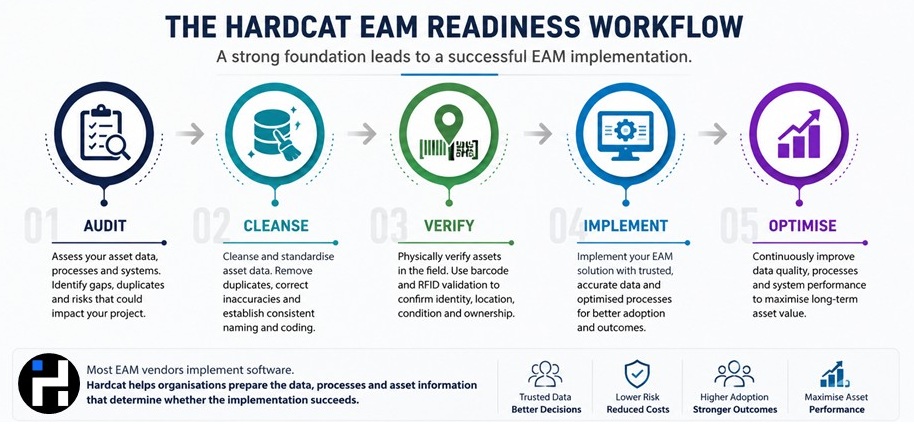
Building a Foundation for Success with Hardcat Services
While every organisation has unique requirements, successful EAM projects are typically supported by four key foundations:
- Strategic alignment
- Accurate asset data
- Efficient business processes
- Stakeholder engagement
Addressing these areas before implementation begins can reduce project risk, improve user adoption, and increase the likelihood of achieving long-term business benefits.
Supporting Successful EAM Implementations
Technology is only one component of a successful EAM project. Organisations also need the right processes, accurate asset information, user engagement, and implementation support to achieve their objectives.
To help organisations reduce implementation risk and accelerate adoption, Hardcat offers a range of professional services that support every stage of the asset management lifecycle. These services can be delivered as part of a complete solution or tailored to specific project requirements.
Consulting, Configuration and Training
From initial requirements gathering through to system configuration, implementation planning, and user training, Hardcat helps organisations align technology with operational objectives. Effective configuration and training support improved user adoption and helps teams realise value from their EAM investment sooner.
Hardware and Tagging Solutions
Accurate asset identification is fundamental to effective asset management. Hardcat provides a range of asset identification technologies, including barcode and RFID solutions, along with tagging strategies designed to improve asset visibility and tracking, and accountability.
Our team works with organisations to recommend the most suitable tags, scanners, mobile computers, RFID readers, and data capture hardware for their specific operational environment. Whether assets are located indoors or outdoors, across healthcare facilities, warehouses, manufacturing sites, utilities, office environments, or field-based operations, Hardcat helps ensure the technology selected is fit for purpose and supports long-term asset management objectives.
Data Capture and Asset Audits
Hardcat’s data capture and asset audit services help organisations verify asset records, improve data quality, identify discrepancies, and establish a trusted foundation for asset management, maintenance planning, and compliance activities. Services include physical asset verification, asset register cleansing, barcode and RFID validation, condition assessments, location audits, and large-scale data capture programs designed to improve confidence in enterprise asset information before implementation begins.
The Hardcat Approach
For more than 35 years, Hardcat has helped organisations across government, defence, healthcare, education, utilities, manufacturing, and commercial sectors improve the way they manage assets, maintenance, compliance, and operational risk.
“Many organisations use the principles outlined in ISO 55000 to develop a structured and sustainable asset management framework”.
– ISO 55000:2024 Asset Management
We believe successful EAM projects begin long before software deployment. The most effective implementations are built on accurate asset data, clearly defined processes, stakeholder engagement, and a strategy that aligns asset management objectives with broader organisational goals.
Every organisation is different, and there is no one-size-fits-all approach to Enterprise Asset Management. Before embarking on an EAM project, organisations should consider:
- What business outcomes are we trying to achieve?
- How does our asset management strategy support broader organisational objectives?
- What level of visibility, governance, and control is required?
- Should asset management activities be centralised, decentralised, or a combination of both?
- What is a realistic roadmap for improving asset management maturity?
- Have stakeholders aligned on priorities, responsibilities, and expected outcomes?
- What operating model will support long-term asset management success?
By answering these questions early, organisations can improve planning, reduce implementation risk, and maximise the value of their EAM investment. To learn more about Hardcat’s implementation methodology and approach to enterprise asset management, visit the Hardcat Approach page.
Planning an EAM implementation?
When planning an EAM implementation, you need to start by understanding the quality of your asset data, business processes, and integration requirements. Hardcat can help reduce project risk through asset audits, physical verification, asset register cleansing, RFID and barcode validation, consulting, and implementation planning services.