Estimated reading time: 11 minutes
Table of contents
- Why Asset Audits Are Critical for Operational Reliability
- You Cannot Manage What You Cannot See
- The Questions Every Asset Audit Should Answer
- The Hidden Link Between Asset Visibility and Reliability
- Downtime Often Begins Long Before Equipment Fails
- Key EAM Capabilities That Simplify Asset Audits
- Asset Audits Are More Than Compliance
- How Often Should Asset Audits Be Performed?
- Why Asset Audits Often Fall Down the Priority List
- The Cost of Poor Asset Data Is Often Hidden
- Asset Audits Create Trusted Asset Intelligence
- Conclusion
- Improve Asset Visibility with Hardcat
As downtime costs continue to rise, organisations are increasingly turning to asset audits to improve asset visibility, strengthen compliance and support operational reliability. What was once viewed as an administrative exercise is now becoming a strategic business process.
For a long time, organisations treated downtime as an unavoidable cost of doing business. When equipment failed, maintenance teams responded, repairs were completed, and operations resumed. While disruptive, the financial impact was often manageable.
Today, however, rising costs are forcing organisations to rethink their approach. As a result, asset audits are becoming a strategic tool for improving visibility, reducing risk and supporting operational reliability.
Why Asset Audits Are Critical for Operational Reliability
Unplanned downtime remains one of the most expensive challenges facing asset-intensive organisations. Despite significant investments in maintenance technologies, condition monitoring systems and digital transformation initiatives, many organisations continue to struggle with operational reliability.
The financial consequences can be substantial. Research from IDS-INDATA estimates that UK and European manufacturers will lose more than £80 billion to downtime in 2025 alone. In some industries, a single hour of downtime can result in millions of pounds in lost production, supply chain disruption and compliance-related costs.
“Many organisations are investing heavily in maintenance and reliability technologies, yet nearly 80% still report the same or higher levels of unplanned downtime than the previous year.”
This raises an important question: Why are organisations continuing to invest heavily in maintenance technologies when reliability improvements remain so difficult to achieve? The answer often comes down to visibility. Many organisations invest in sophisticated maintenance strategies, predictive technologies and monitoring systems, yet the underlying asset data used to support those initiatives is incomplete, inaccurate or out of date.
When organisations lack confidence in their asset information, maintenance teams are forced to make decisions based on assumptions rather than facts. This is where asset audits play a critical role. By verifying the existence, location, condition and compliance status of assets, organisations establish the trusted asset intelligence needed to improve maintenance planning, reduce downtime and support operational reliability.
You Cannot Manage What You Cannot See
Many organisations believe they have accurate visibility of their asset base. However, asset registers often contain outdated, incomplete or inaccurate information that can undermine maintenance, compliance and operational decision-making.
In reality, asset data gradually degrades over time. Equipment is moved, maintenance records become incomplete, assets are replaced and locations change without updates being reflected in the asset register. So, most of these problems won’t get noticed even during a normal run. They only show up when a situation arises. When major equipment fails, the business needs prompt responses to several questions:
- Where is the equipment?
- What is its condition?
- Has it been inspected lately?
- Is maintenance overdue?
- Are replacement parts in stock?
- Is the company still compliant?
The Questions Every Asset Audit Should Answer
- What assets do we own?
- Where are they located?
- Who is responsible for them?
- Are they compliant?
- Are they being maintained?
- Are they still required?
Downtime increases quite fast when asset information is not accurate. The problem does not necessarily lie in the absence of a solution. What is actually missing is reliable information in a central system. The challenge is not necessarily a lack of technology. It is a lack of trusted asset intelligence.
The Hidden Link Between Asset Visibility and Reliability
Many organisations base their reliability plans on maintenance work. Preventative maintenance schedules are optimised, monitoring systems are deployed, and technicians are trained more thoroughly. All of these are great initiatives but there is one basic prerequisite that they depend on: the availability of correct asset information.
When asset information is incomplete, inaccurate or out of date, even the most sophisticated maintenance strategy can become reactive rather than proactive. Maintenance teams are forced to make decisions based on assumptions rather than reliable data, increasing the risk of unexpected failures and operational disruption.
This is one of the key reasons asset audits are receiving renewed attention from organisations focused on improving reliability.
Performing asset audits on a regular basis helps organisations establish confidence in the accuracy and completeness of their asset data. By improving asset visibility through Proof of Presence verification, audits confirm that assets physically exist, are correctly recorded, comply with regulatory requirements, and remain fit for their intended purpose.
Downtime Often Begins Long Before Equipment Fails
One of the most overlooked causes of downtime is not equipment failure itself, but the inability to respond efficiently when issues occur. Consider the impact of a missing asset, misplaced tool or unavailable spare part.
Maintenance teams can spend valuable hours searching for equipment, arranging replacements or validating asset information before repairs even begin. In critical environments, these delays can significantly extend outage durations and increase operational risk.
Organisations that maintain accurate asset records and perform regular verification activities (asset audits) are far better positioned to respond quickly when failures occur.
Visibility becomes a competitive advantage.
Key EAM Capabilities That Simplify Asset Audits
Modern enterprise asset management systems provide several capabilities that make asset audits faster, more accurate, and easier to defend during compliance reviews. The following features help organisations maintain complete visibility over their asset estate while supporting financial, operational, and regulatory audit requirements.
The following capabilities are commonly found in modern enterprise asset management platforms and play a critical role in supporting asset audits.
| Audit Capability | Purpose | Business Benefit |
| Immutable Audit Trails | Automatically records who made a change, what was changed, and when it occurred. | Provides complete transparency and accountability for audits and investigations. |
| Centralised Documentation | Stores maintenance history, inspection certificates, compliance records, and financial data in a single repository. | Creates a single source of truth and simplifies audit preparation. |
| Automated Regulatory Reporting | Generates real-time reports aligned to industry regulations, safety standards, and compliance frameworks. | Reduces manual effort and ensures timely, accurate compliance reporting. |
| Lifecycle Tracking | Tracks assets from procurement through operation, maintenance, and disposal. | Demonstrates governance compliance and provides full asset traceability. |
| Financial Audit Support | Aligns purchasing records, depreciation schedules, and maintenance expenditure with accounting systems. | Improves financial accuracy and supports internal and external financial audits. |
| Safety & Regulatory Audit Support | Provides verifiable evidence of preventive maintenance, safety inspections, and operator certifications. | Helps demonstrate compliance, reduce risk, and pass regulatory audits with confidence. |
Together, these capabilities transform asset audits from a reactive compliance exercise into a proactive governance process. By maintaining accurate records, automating reporting, and providing complete asset traceability, organisations can reduce audit preparation time while improving compliance outcomes.
Asset Audits Are More Than Compliance
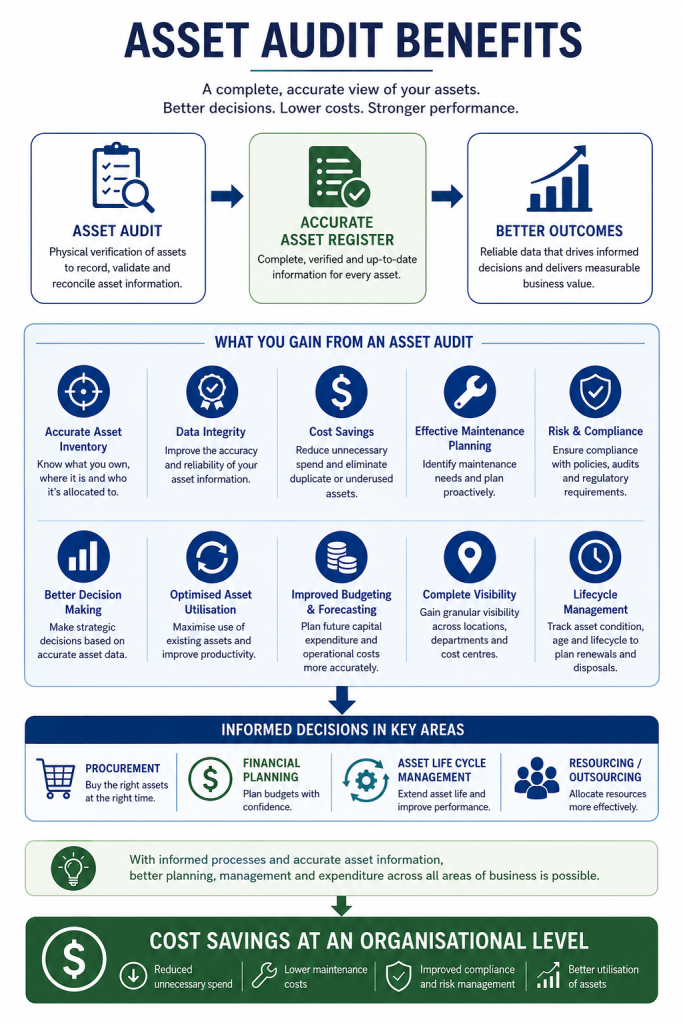
While asset audits are often associated with compliance and financial reporting, their value extends far beyond meeting regulatory requirements. Organisations that maintain accurate and verified asset information are better equipped to make informed operational, maintenance and investment decisions.
Accurate asset data supports more effective maintenance planning by ensuring teams have visibility of asset condition, location and service history. This enables maintenance activities to be scheduled proactively, reducing the likelihood of unexpected failures and helping minimise costly downtime.
Asset audits also improve capital planning by providing organisations with a clear understanding of the assets they own, their utilisation levels and their remaining useful life. This visibility helps prevent unnecessary purchases, supports more accurate budgeting and enables better investment decisions.
In addition, regular audits can improve asset utilisation by identifying underused, duplicated or misplaced assets that may otherwise remain hidden within the organisation. This allows businesses to maximise the value of existing resources before investing in new equipment.
From a governance perspective, asset audits provide confidence that asset records are accurate, current and auditable. This strengthens accountability, supports compliance obligations and provides decision-makers with trusted asset intelligence.
Ultimately, organisations that view asset audits as a strategic business process rather than a compliance exercise are better positioned to improve operational performance, reduce risk and maximise the value of their assets throughout the lifecycle.
How Often Should Asset Audits Be Performed?
Audit frequency will vary depending on asset criticality, risk profile and regulatory requirements. As a general guide:
| Asset Type | Suggested Frequency |
| High-risk assets | Quarterly |
| Mobile assets | Quarterly |
| Critical infrastructure | Six monthly |
| General equipment | Annually |
| Financial assets | Annually |
Why Asset Audits Often Fall Down the Priority List
Most organisations know audits are important, yet many still don’t perform them regularly. The challenge is that many organisations still approach asset audits as they did a decade ago. Modern mobile asset auditing technologies have largely eliminated the need for paper-based processes and manual data reconciliation.
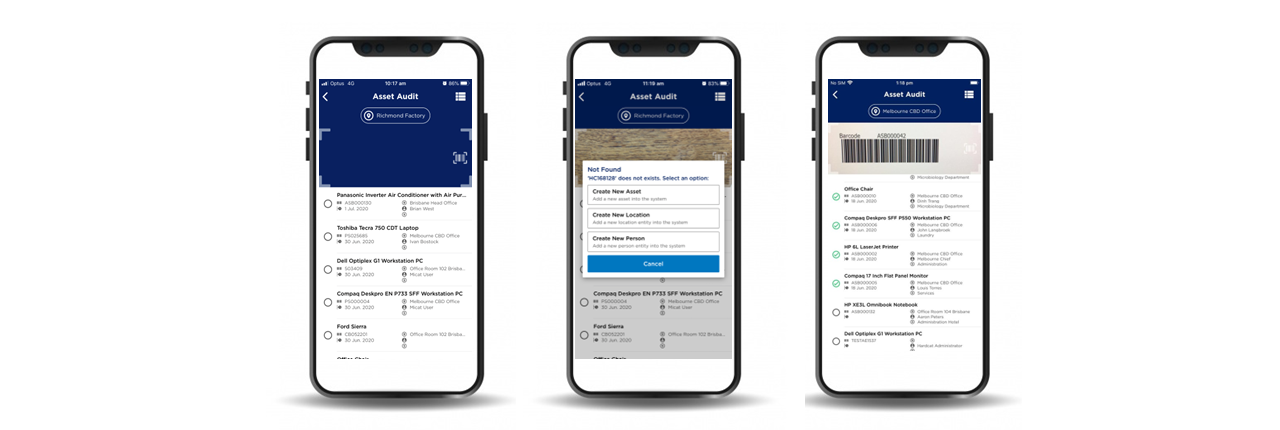
Using barcode, RFID and mobile applications, organisations can now verify thousands of assets quickly and accurately while updating enterprise asset records quickly. What was once a resource-intensive annual exercise can become a routine operational activity that continuously improves asset visibility and supports better maintenance decisions.
Typical reasons not to perform an asset audit include:
1. They are seen as an administrative exercise
Many organisations view asset audits as a compliance or finance activity rather than an operational strategy. As a result, audits are often conducted only when:
- Financial year-end approaches
- An external audit is scheduled
- A regulatory requirement exists
- A problem has already occurred
The operational benefits of asset visibility, maintenance planning and risk reduction are frequently overlooked.
2. Asset audits are traditionally labour intensive
Historically, asset audits required teams to:
- Walk facilities and manually check assets against spreadsheets or printed asset registers.
- Locate hard-to-find assets across large sites, warehouses, plants or remote locations.
- Manually verify asset details such as serial numbers, condition, maintenance status, and location.
- Update database records manually, increasing the risk of data entry errors and data inconsistencies.
- Reconcile audit findings with multiple systems, spreadsheets, and maintenance databases.
- Investigate missing, misplaced, or duplicate assets through time-consuming follow-up activities.
- Coordinate audit activities across multiple sites, departments, and contractors.
- Generate reports manually, often days or weeks after the audit has been completed.
- Repeat the process regularly to maintain compliance with internal policies, regulatory requirements, or financial reporting standards.
For organisations with thousands of assets across multiple sites, this can be time-consuming and expensive. Consequently, audits are postponed because maintenance teams are focused on day-to-day operational demands.
3. Organisations believe their data is accurate
Many organisations assume their asset registers are accurate because they have:
- An EAM
- A CMMS
- An ERP system
- Spreadsheets
However, systems are only as accurate as the information entered into them.
- Assets move
- Equipment is replaced
- Assets are retired
- Locations change
Without verification, data quality gradually deteriorates.
4. Limited resources and competing priorities
Maintenance teams are often focused on keeping operations running, leaving little time for proactive verification activities.
5. Lack of ownership
Asset information often sits between multiple departments:
- Operations
- Maintenance
- Finance
- Procurement
- IT
When nobody owns the ongoing accuracy of asset data, audits become irregular and inconsistently managed.
The Cost of Poor Asset Data Is Often Hidden
Perhaps the greatest challenge with poor asset data is that its impact is rarely visible on a balance sheet. Organisations can easily identify the cost of a new asset management system, an audit program or a maintenance initiative. What is far more difficult to measure is the cumulative cost of inaccurate, incomplete or outdated asset information.
Unlike a major equipment failure, poor asset data does not typically create a single, identifiable event. Instead, its effects are dispersed across the organisation, quietly eroding operational efficiency and increasing risk.
A technician spends valuable time searching for equipment that should be available. A department purchases a replacement asset because the original cannot be located. Maintenance activities are delayed because asset records are inaccurate or incomplete. Spare parts are overstocked as a precaution because inventory information cannot be fully trusted.
Poor asset data increases downtime, costs and risk.
Many organisations also carry excess inventory as a buffer against uncertainty, tying up capital in spare parts and equipment that may never be used. At the same time, other assets remain underutilised because decision-makers lack accurate information about their availability, condition or utilisation.
The result is a hidden operational cost that touches multiple departments, from maintenance and operations to finance, procurement and compliance. Because these costs are distributed throughout the organisation, they are rarely linked back to the quality of asset data itself.
This is why asset audits are so important. They provide organisations with confidence that the information used to make operational, maintenance and investment decisions is accurate, current and reliable. Without that foundation, even the most sophisticated asset management strategies can be undermined by poor visibility and incorrect assumptions.
Asset Audits Create Trusted Asset Intelligence
The value of an asset audit extends beyond verifying the existence and location of assets. Regular audits help organisations build trusted asset intelligence by ensuring asset registers remain accurate, complete and up to date. When decision-makers can rely on asset information, they are better equipped to manage risk, allocate resources and plan for the future.
Verified asset registers provide maintenance teams with confidence that they are working with accurate information, enabling more effective maintenance planning and reducing the likelihood of unexpected downtime. They also strengthen audit readiness by providing clear, verifiable records that support financial, operational and regulatory compliance requirements.
Most importantly, trusted asset intelligence improves operational decision-making. From maintenance scheduling and capital planning to asset utilisation and compliance management, organisations can make better decisions when they have confidence in the quality of their asset data. Asset audits provide the foundation for that confidence.
Conclusion
As downtime becomes more expensive and operational environments more complex, organisations can no longer afford uncertainty around their assets. Regular asset audits provide the foundation for accurate asset data, improved visibility and stronger operational decision-making.
Organisations that treat asset audits as a strategic business process—not simply a compliance exercise—are better positioned to reduce downtime, improve compliance and maximise asset performance. By investing in trusted asset intelligence, businesses can reduce risk, improve reliability and make better decisions across the entire asset lifecycle.
Organisations that perform regular asset audits are not simply maintaining compliance—they are building the trusted asset intelligence required to improve reliability, reduce downtime and make better business decisions.
Improve Asset Visibility with Hardcat
Hardcat solutions on the Google Play Store and Apple App Store enable organisations to rapidly verify assets, manage risk and compliance, identify discrepancies and maintain trusted asset intelligence across multiple sites and thousands of assets.
Using Hardcat’s Mobile Asset Management solution, audit teams can rapidly identify and capture newly discovered assets, verify asset locations and status in the field, update records in real time, record asset condition information, and instantly synchronise data with central asset registers.
To learn how Hardcat can help your organisation improve asset visibility, reduce downtime and strengthen operational readiness, explore our Asset Audit Solutions or contact our team for a demonstration.