EAM (Enterprise Asset Management) software is boosting resilience in organisations. It’s not about tracking inventory but focusing on making data-driven decisions that brings value. This helps improve business performance faster and smarter. Companies are also adding sustainability to asset operations. They face growing pressure from stakeholders and regulators.
Optimising asset purchases and capital investments shows how data-driven choices work in enterprise asset management (EAM). It goes beyond maintenance efficiencies. EAM software looks at usage patterns, asset performance data, and lifecycle costs. This helps to decide when and what new assets to buy.
An organisation can decide to redeploy, upgrade, or replace underperforming or underutilised assets. They do this by looking at detailed cost analyses and utilisation reports. This approach moves beyond gut feelings and old replacement schedules. It ensures that the organisation spends money on assets that offer the most value and meet its needs.
Hardcat prominent feature list
- Centralised asset register with full lifecycle tracking—from acquisition to disposal.
- Integrated asset tracking using barcodes, RFID, GPS, or Bluetooth (Asset Tracking).
- Preventive, predictive, and reactive maintenance scheduling and tracking.
- Audit-ready compliance with full traceability for ISO55001 and regulatory needs.
- Advanced analytics and reporting for data-driven decisions and performance monitoring.
- Mobile field workforce support—native iOS/Android apps with offline mode.
- Flexible integration with ERP, HR, finance, and IoT platforms.
- Chain of custody and accountability for sensitive or regulated environments.
- Scalable for all industries—see our industries pages.
EAM platforms also help with asset deployment. They use data to find the best way to allocate new equipment. This approach boosts productivity and cuts down on unnecessary spending. This smart, data-focused way of buying and allocating helps improve financial results and strengthens business resilience.
In this article we explore the power of EAM software and why it is a lifeline for organisations. Fortifying resilience and revolutionising organisational dynamics. With EAM, companies elevate asset performance while minimising risks. Stay ahead of the curve in a world where change is the only constant.
Enterprise asset management: optimising business assets
An EAM system enables organisations to maintain their physical assets including tools, equipment, machinery, buildings and vehicles throughout their entire lifecycle. The main objective of this effort is to increase the value and effectiveness and lifespan of assets while minimising costs, risks and downtime.
Features and Benefits Table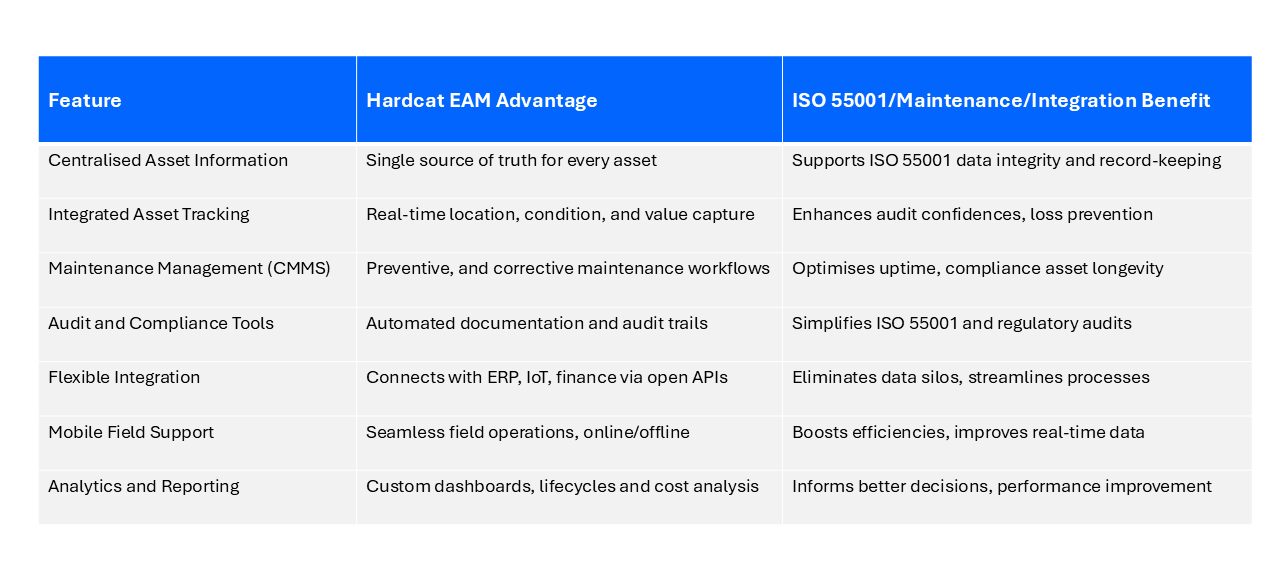
Organisations use a combination of special applications and tools, technologies and best practices to plan, optimise, deploy and monitor their asset-related operations. The EAM system includes maintenance work, store inventory and compliance monitoring and asset value understanding for financial planning purposes.
What is data-driven decision making?
The process of data-driven decision making (DDDM) involves collecting asset data through your company’s Key Performance Indicators (KPIs) before converting this data into useful insights. Data-driven decision making enables organisations to select better choices which lead to increased profitability and sustainable business success.
The process of making crucial workplace decisions becomes challenging because you need to choose between different options. Relying only on instinct provides you with confidence but it fails to produce the most beneficial results for your team or organisation. Using data to support your decision-making process provides you with assurance that your choices are backed by evidence while focusing on delivering quantifiable business outcomes.
DDDM serves as a critical factor for organisations to maintain their competitive edge and achieve profitability. Organisations that base their decisions on factual analysis instead of gut instinct reduce their chances of making expensive errors and produce decisions of higher quality and consistency. The approach minimises both the chance of resource mismanagement and monetary losses.
EAM software and navigating change in 2025
We are seeing a shift: asset management is becoming a core enabler of operational resilience and strategic growth. Whether it is leveraging real-time data, mobile-first field solutions, or predictive maintenance, businesses are adopting smarter tools to stay agile and in control.
The development of EAM software continues to accelerate because organisations must address emerging challenges and seize new possibilities during 2025. Organisations adopt sophisticated EAM systems because their assets have become more complex. While regulatory requirements grow stronger and operational flexibility becomes essential for driving resilience and value creation.
But asset management isn’t just a plan, policy or a piece of technology. It is a mindset. A way of thinking about how your assets support your mission, your people, and your future. Hardcat helps leaders like you build an asset management culture that sticks.
From Data to Decisions: Elevate Asset Management Performance
By implementing a robust enterprise data strategy, organisations can fully unlock the value of their asset data by centralising all information within a single, accessible platform. Near real-time asset tracking and a comprehensive asset register ensure that every asset’s status, location, and history are always up to date, eliminating data silos and reducing guesswork. Let’s explore how ISO55001 (Implementation, compliance, EAM best practices) empowers organisations to make informed decisions through data-driven practices.
Data embedded in every decision, interaction, and process: Organizations often apply data-driven approaches—from predictive systems to AI-driven automation—sporadically throughout the organization, leaving value on the table and creating inefficiencies. Many business problems still get solved through traditional approaches and take months or years to resolve. McKinsey: The data-driven enterprise of 2025
The Role of Leaders in Data-Driven Decision-Making
Leaders are crucial for advancing data-driven asset management which includes:
- Defining data policies through establishing organisational-wide standards for data collection, analysis and usage.
- Investing money in technology which enables teams to manage data through modern tools and platforms.
- Provides staff members with data interpretation training that enables them to convert knowledge into meaningful organisational action.
- Promotes combined work between different departments to optimise data-driven decision making.
Key ISO55001 Principles for Effective Data Utilisation
ISO55001:2024 emphasises data importance in asset management systems by establishing these core principles:
- Data Integrity: Maintaining data accuracy, completeness, and reliability.
- Performance Monitoring: Leveraging data to track asset performance and pinpoint improvement opportunities.
- Risk Analysis: Using data-driven insights to assess risks and develop effective mitigation plans.
- Continuous Improvement: the organisation needs to use data insights for continuous improvement of its asset management strategies.
Advantages of Data-Driven Asset Management
Organisations that embrace data-driven approaches benefit in several ways:
- Make decisions based on dependable and current information which leads to more accurate results.
- Improve efficiency through the identification of operational inefficiencies that lead to better asset performance.
- Become proactive in risk management by using advanced analytics to detect future problems.
- Better direct resources to deliver the highest value and return on investment at maximum efficiency.
Steps to Implement Data-Driven Asset Management
The first step to implementing data-driven asset management with ISO55001 compliance requires organisations to evaluate their data requirements. The organisation needs to identify which data types best support their asset management goals while collecting all relevant information needed for decision-making.
Next, the organisation needs to create an extensive data strategy as its following step. The strategy should explain the entire process for data acquisition as well as analysis within the organisation. Maintaining data processes which are reliable and consistent and aligned with business objectives through a defined strategy.
Finally, the organisation must implement specialised tools and systems that allow efficient data collection and analysis. Technology systems allow teams to collect precise data which they can convert into meaningful information that leads to better asset management results.
The result? Real-time intelligence that supports every asset decision in a data-driven approach. Resulting in improved efficiency while minimising risk to maximise investment value from the asset base.
EAM software for long-term asset management success
Organisations that lead their operations maintain asset management as an organisational mindset which unites all team members behind business mission, values and strategic objectives. The development of effective asset management cultures operate through strong leadership combined with clear communication and continuous improvement dedication.
This results in a proactive data-driven environment while embedding asset management values throughout their organisational structure. Achieving better asset value and improved risk management and sustainability.
Hardcat works with leaders to establish these cultural foundations which elevates asset management into a strategic business advantage instead of a mere compliance requirement. Our collaboration will establish an asset management excellence culture which supports your mission, your people and your future.
Five ways EAM software is driving resilience, visibility, and value

AI Driven Predictive Maintenance
Artificial intelligence can elevate maintenance operations through its ability to analyse past data to forecast equipment breakdowns ahead of time. Organisations achieve better performance through this proactive maintenance strategy which cuts unplanned downtime expenses while extending asset life expectancy.
Real-Time Asset Visibility and Analytics
EAM systems today offer organisations real-time access to asset performance data and usage statistics and historical maintenance records within a centralised platform. Organisations can boost their operational efficiency and reduce costs through advanced analytics and reporting tools which help them identify trends and optimise resource allocation.
Enhanced Operational Resilience
EAM systems enhance operational resilience through their ability to support comprehensive continuity planning and risk mitigation strategies. Digital platforms enable organisations to quickly adapt to disruptions. Organisations can maintain business continuity and meet regulatory requirements through EAM systems.
Cloud-Based Accessibility and Collaboration
Cloud-based EAM solutions provide scalability, remote access, and seamless collaboration. Across teams and locations this flexibility enhances responsiveness. The system optimises workflows through updated information sharing which creates an agile connected organisation.
Integration with IoT and Other Business Systems
EAM platforms connect with IoT devices as well as ERP systems and warehouse management systems. Providing a complete view of asset conditions and operations. The integration between systems enables automated monitoring and better inventory control and more accurate forecasting which drives both value and efficiency.
Enterprise maintenance planning tools
Organisations need tools such as Computerised Maintenance Management Systems (CMMS) and Enterprise Asset Management (EAM) software to maintain operational excellence. These platforms enable organisations to track maintenance needs as well as enhance planning capabilities, maintenance work and monitoring functions.
The result? An operation which experiences reduced downtime and lower costs together with enhanced efficiency. These tools enable the following functions for your organisation:
Asset Tracking
EAM software let you keep tabs on all your assets, whether it is equipment, buildings, or even expensive tools. You get a clear picture of everything your organisation owns and relies on.
Work Order Management
Need to get something fixed? EAM systems enable quick work order creation, assignment and follow-up, so maintenance tasks become faster while preventing errors in tracking.
Spare Parts Management
A shortage of spare parts generates serious difficulties for your operations. The EAM system enable organisations to monitor spare parts and track their consumption for optimal inventory levels while preventing excessive orders.
Reporting and Analytics
Do you want to evaluate the performance and utilisation of your assets? EAM tools provide detailed reports for identifying trends and measuring performance which helps users make better decisions from actual data.
Preventive Maintenance Scheduling
Don’t wait for things to break! These tools let you plan scheduled maintenance and perform inspections in-the-field via mobile devices. Helping to prevent equipment failures while maximising the usable lifespan of your assets. Modern organisations can transition from reactive to proactive maintenance approaches through advanced technology implementations which enables them to extend asset lifecycles while ensuring compliance.
-
Proactive Strategies: The combination of real-time data, IoT sensors and analytics in modern EAM solutions performs predictive and preventive maintenance tasks to schedule interventions before equipment failures become imminent. The implementation of proactive strategies leads to lower unplanned equipment stoppages and longer asset duration as well as reduced expenses for emergency maintenance.
-
Automated Scheduling: Automated work order creation and maintenance scheduling ensure assets are serviced at optimal intervals, reducing risk and improving reliability.
Optimising Asset Lifecycles
Organisations need complete asset records across the entire lifecycle. From purchase and use, to maintenance and either final disposal or refurbishment. Comprehensive records support better decisions on repairs, replacements, cost optimisation, and asset retirement planning. Mobile app field operations let technicians access, update, and complete work orders in real time, providing immediate, accurate asset information and reducing administrative costs.
Ensuring Governance, Risk and Compliance
Organisation must achieve compliance with industry-specific regulations and verify their asset management practices follow all relevant legal and regulatory requirements. Reliable asset information provides the peace of mind required to confidently address an organisation’s GRC needs and help realise the implementation of the ISO55001 standards framework. A sustainable GRC organisation should have a framework and management structure which include clearly defined roles, responsibilities, activities and systems to analyse and manage each recognised aspect of GRC.
Shaping the future of asset management systems
Organisations are rethinking their facility and asset management approaches because of economic uncertainty, digital transformation speed and environmental and compliance standards pressures. Your asset value maximisation begins with effective asset management and understanding.
“Next-Gen Enterprise Asset Management systems function by integrating advanced tools, technologies such as Business Intelligence (BI) platforms, and workflows to streamline asset management across the organisation. Empowering organisations with intelligence and predictive capabilities. Transforming asset oversight from a reactive task into a strategic driver of resilience and innovation.”
Hardcat enables you to integrate IT (Information Technology) and OT (Operational Technology) data into a single asset base view through its unified platform. Hardcat uses advanced analytics and integrated AI-driven insights to help organisations extract maximum value throughout the entire asset lifecycle. Our strong digital infrastructure enhances operational efficiency and supports customer experience and growth initiatives which lead to long-term organisational success.
Hardcat’s Differentiators
| Feature | Hardcat EAM Software Advantage |
|---|---|
| Integrated EAM & Maintenance | Seamlessly combines asset management, maintenance, inventory, and financial tracking in one platform. |
| Mobile Workflow Support | Native iOS/Android apps for work orders, audits, and asset tracking-even offline, boosting field efficiency. |
| Real-Time Insights | Dashboards, analytics, and reporting provide actionable insights for better decision-making. |
| Compliance & Audit Readiness | Complete audit trails, compliance, and automated documentation for regulatory needs. |
| Flexible Integration | Easily connects with ERP, HR, and IoT systems-creating a single source of truth and eliminating silos. |
| User-Friendly Interface | Intuitive, configurable UI reduces training needs and increases adoption across the organisation. |
Tips for implementing EAM strategies in your organisation
Set Clear Goals and KPIs
The first step in EAM implementation requires defining your organisation’s target outcomes whether you want to reduce downtime or decrease costs or enhance compliance standards. You must create quantifiable KPIs to monitor both progress and success.
Involve Key Stakeholders
The maintenance team along with IT personnel and operations staff and executive leadership should participate in the process from the beginning to gain their support and ensure the system meets their actual requirements.
Ensure Data Quality
Your asset data requires cleaning and standardisation before migrating to a new system. The reliability of data serves as the essential base for both analytics and decision-making processes.
Leverage Modern Software
Select an EAM platform which provides mobile access and real-time data capture capabilities. Cloud-based solutions enable faster deployment while supporting teams who work remotely.
Standardise Processes
The organisation should create uniform procedures for asset tracking and maintenance and reporting activities. Standardised processes eliminate confusion while saving time and making audits simpler.
Prioritise Preventive and Predictive Maintenance
Moving from reactive maintenance to scheduled and data-based maintenance practices will help extend asset lifespan while reducing expensive breakdowns.
Encourage Cross-Department Communication
Your EAM system should enable different departments to share information which prevents duplicate work and missed maintenance tasks.
Train Your Team
The effectiveness and confidence of your employees using EAM system features depends on receiving complete training. The provision of detailed instruction allows your employees to reach the highest level of system performance. Your team will gain better capabilities to perform daily tasks efficiently and learn new system features that get added to the system.
Conclusion: preparing your organisation for the future
Enterprise Asset Management (EAM) software operates as an active tool. The strategic implementation of EAM software drives organisational resilience, sustainability, visibility and value creation in 2025 and beyond. Organisations that implement AI predictive maintenance, real-time analytics, cloud-based collaboration and IoT will achieve maximum asset uptime, operational cost reduction and data-driven decision making.
EAM continues to evolve through emerging technologies which will deliver enhanced operational efficiency and intelligence. Your organisation needs to evaluate its current asset management maturity level to determine existing process weaknesses and potential improvement areas.
- Establish leadership support for EAM strategic value through team engagement.
- Select EAM solutions that are both powerful and adaptable for future growth.
- Create a data-driven environment by providing training and establishing clear data policies for your teams.
- Work with trusted experts including Hardcat to speed up your transformation process.
Your organisation can achieve maximum asset potential and future security by taking the next step. Contact Hardcat experts to begin your path toward smarter asset management with increased resilience.