When Intelligence Becomes Abundant, Trust Becomes the Advantage.
Asset intelligence is the ability to turn accurate asset information into insights that support better operational decisions.
Artificial intelligence is changing the way organisations collect, analyse and act on information. Systems can process enormous volumes of data, identify patterns, generate insights and increasingly make recommendations in seconds. As these capabilities become more accessible, intelligence itself is becoming abundant.
But abundance creates a new question: What happens when organisations have more intelligence than they can confidently trust? For asset-intensive organisations, this question matters.
AI can analyse an asset register. It can identify maintenance patterns, highlight anomalies, predict potential failures and help decision-makers understand complex operational information. But AI cannot make inaccurate asset data accurate simply by being intelligent.
If an organisation does not know whether an asset is where the system says it is, the data cannot be fully trusted. The same applies if its status is out of date, its ownership is incorrect or its maintenance history is incomplete. More sophisticated analysis does not remove that uncertainty. It can simply make decisions based on uncertainty faster.
The future of asset intelligence may not be determined by how much intelligence an organisation can generate. It may be determined by how much of that intelligence it can trust.
Intelligence is only as good as the information beneath it
The conversation around AI often focuses on capability.
- How much information can it process?
- How quickly can it identify patterns?
- What predictions can it make?
- How effectively can it automate decisions?
These are important questions. But there is another question that deserves equal attention: Can the organisation trust the information on which those conclusions are based?
Consider a simple asset-management scenario. An organisation asks an intelligent system to identify assets approaching the end of their useful life. The system analyses acquisition dates, depreciation, maintenance records, usage and other available information.
The analysis may be sophisticated. But what if some asset records are duplicated? What if several assets have incorrect acquisition dates? What if equipment has been relocated without the asset register being updated? What if maintenance information is incomplete?
The intelligence may still look convincing. That is the problem. Intelligence can expose patterns in data, but it cannot automatically establish that the data reflects reality. For asset-intensive organisations, that distinction is critical.
Accuracy comes first
For asset information to support confident decisions, organisations need processes that verify what exists, where assets are located and whether the information recorded reflects reality. Asset verification, physical audits and effective asset management systems all play a role in establishing and maintaining this level of accuracy. The objective is not simply to collect more information, but to ensure the information being used can be relied upon.
Before asset information can become trusted intelligence, it needs to be accurate. Accuracy means more than having an asset register. It means having confidence that the information represents the physical and operational reality of the organisation.
That includes knowing:
- What assets exist
- Where they are located
- Who is responsible for them
- What condition they are in
- What has happened to them throughout their lifecycle
- What maintenance or other activity has occurred
- Whether the information is current
- Whether the information can be relied upon for the decision being made
This is why physical asset management remains important in an increasingly digital environment. Technology can make information easier to collect, connect and analyse. But organisations still need effective processes for verifying that information and keeping it current.
Accurate data is the foundation on which everything else depends
Accuracy needs governance. Accurate information does not stay accurate by accident.
- Assets move
- People change roles
- Equipment is repaired, replaced or disposed of
- Organisations restructure
- Responsibilities change
- New systems are introduced
Without appropriate processes and accountability, asset information can gradually drift away from reality. This is where governance becomes critical.
Governed asset information has defined processes around how information is captured, changed, verified and maintained. There is accountability for the information, appropriate controls over changes and an auditable history of what has happened.
Governance turns asset data from something that is simply recorded into something that can be managed with confidence.
Trust is earned, not assumed
Trust in asset information should not be based simply on the fact that the information exists in a system. It comes from confidence in how that information was captured, maintained and governed.
A trusted asset record is one where an organisation can reasonably answer: Can we rely on this information?
That confidence becomes increasingly important as organisations introduce more sophisticated analytics, automation and AI into their operations. If people do not trust the underlying asset data, they may hesitate to act on the insights produced from it.
The technology may be capable. The analysis may be impressive. But the organisation still lacks the confidence required to make the decision. Trust is therefore becoming an increasingly important asset in its own right.
The AI paradox: more intelligence can increase the cost of bad data
There is an uncomfortable possibility in the rapid adoption of AI. The better AI becomes, the more consequential poor-quality data may become. When a spreadsheet contains an error, the consequences may be limited to a particular calculation.
When a poorly maintained asset register feeds an increasingly automated intelligence system, the consequences can potentially extend much further.
The system may identify the wrong priority.
- It may recommend the wrong action.
- It may overlook an important risk.
Or it may present an incorrect conclusion with a level of confidence that makes it appear more credible than it actually is. This is why the rise of AI should not reduce the focus on data quality. It should increase it.
The objective should not simply be to give AI more data. It should be to give intelligent systems better data to work with.
From trusted data to actionable intelligence
This brings us to the final stage:
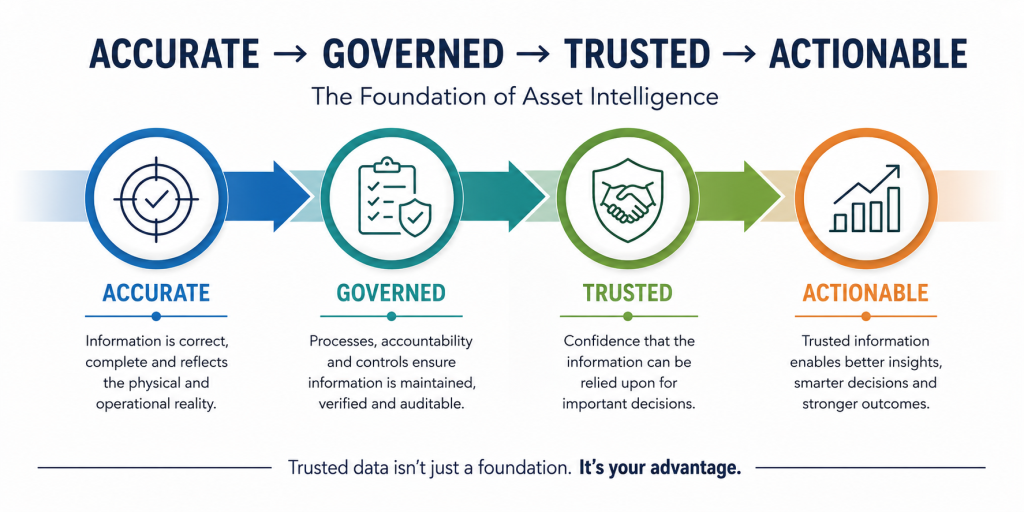
Once asset information is accurate, governed and trusted, organisations are in a much stronger position to use intelligence effectively.
- Analytics can help identify trends.
- Automation can help streamline processes.
- Predictive technologies can help identify potential issues.
AI can help organisations interpret complex information and surface insights that may otherwise be difficult to identify. But the value comes when those insights can support confident action.
The objective isn’t intelligence for its own sake. It is better decisions.
- Better maintenance decisions.
- Better utilisation decisions.
- Better investment decisions.
- Better risk decisions.
- Better operational decisions.
Trusted data gives intelligence somewhere solid to stand
There is another dimension to this discussion. Trust in intelligent systems will not be determined entirely by technology. People need to understand where information comes from, how it is maintained and why they should have confidence in it.
That means organisations need transparency, accountability and appropriate governance around their information. This becomes particularly important as AI-generated recommendations become more common.
The question will increasingly move from “What does the system tell us?” to “Why should we trust what the system tells us?” Organisations that can answer that question confidently will be better positioned to adopt emerging technologies responsibly.
The future belongs to trusted intelligence
AI will continue to evolve.
Its ability to analyse information, identify patterns and support decision-making will almost certainly continue to expand. But the fundamental importance of accurate asset information will not disappear. If anything, it will become more important.
The organisations best positioned to benefit from increasingly intelligent technologies will not necessarily be those with the most data or the most sophisticated AI tools.
It will be those that understand the importance of establishing accurate, governed and trusted information before asking technology to turn it into intelligence.
Because when intelligence becomes abundant, another resource becomes scarce: trust. And for asset-intensive organisations, trust starts with knowing that the information about their assets can be relied upon.
The future of asset intelligence is not simply about generating more intelligence. It is about having the confidence to act on it.