
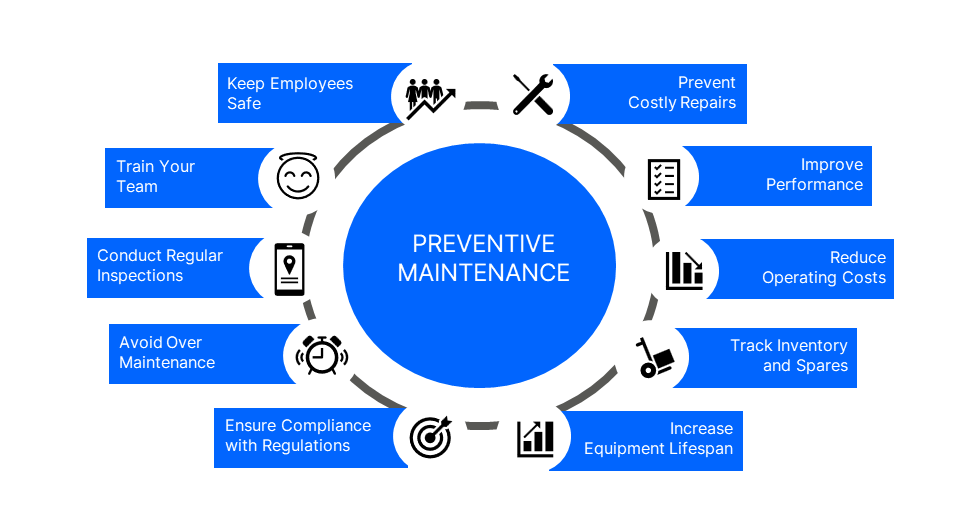
Preventive maintenance and timely machinery inspections are critical for workplace safety. Ensuring the maintenance work performed in a safe manner not only optimises the longevity of the assets but keeps workers safe. Tasks that involve risks and pose threats to maintenance crews require proper safety protocols during inspection and maintenance activities.
Some maintenance tasks can pose risks to workers, these typically involve activities with exposure to hazardous conditions, physical strain, or complex procedures.
Preventive maintenance and effective decisions
Compliance in preventive maintenance is a Key Performance Indicator (KPI) that measures the performance over time for maintenance tasks. KPIs provide targets for maintenance teams, a milestone to gauge progress, and how well a schedule is being followed. These insights help the organisation make effective decisions around maintenance processes.
Industries such as mining and manufacturing carry equipment that poses a risk to both the operator and the maintenance crew. These expensive assets are subject to safety regulations and require compliance with regular schedules. By observing industry-specific regulations, organisations can safeguard their workplace.
Enterprise Asset Management (EAM) systems assist with providing proof of compliance by maintaining comprehensive records and associating certifications to the asset record.
Balancing safety and maintenance deadlines
When setting up maintenance tasks, you need to decide which to do and how often to do them. Give safety guidelines and risk assessments precedence. Perform checks before initiating any maintenance work and schedule the tasks based on the results. How do you ensure safety protocols aren’t compromised?
-
When faced with stringent deadlines, prioritise the tasks that are critical to safety.
-
Delegation is key to managing tight deadlines effectively.
-
Use checklists; checklists are a mechanical engineer’s best friend when it comes to ensuring nothing is missed during maintenance.
-
Regular reviews of maintenance procedures and safety protocols can help identify potential shortcuts that might be taken under deadline pressures.
-
Continuous training is essential for keeping safety protocols front of mind, especially when under pressure to meet deadlines.
-
Close monitoring during maintenance activities is crucial. This doesn’t mean micromanaging every detail but rather keeping a watchful eye on the overall process to ensure that safety protocols are being followed.
Maintenance efficiency and safety standards
Work Health and Safety (WHS) guidelines in your industry/country are the regulatory frameworks primarily responsible for improving the workplace and safety of workers. These standards aim to protect workers; it is vital to integrate these standards into your maintenance plans and perform all maintenance activities under these regulations. Never skimp on adhering to these standards to meet a deadline. Worker safety should always be the priority over speed or convenience.
For industries with distributed fixed assets, maintenance efficiency is not only about reducing non-value-added activities. Reducing travel time (and idle time) and avoiding unnecessary trips are equally important, lowering safety risks at the same time. Optimised planning, scheduling, dispatching, and routing as well as small maintenance team sizes are key levers for increasing productivity while keeping or even increasing asset availability levels. The-future-of-maintenance-for-distributed-fixed-assets (mckinsey.com)
Conclusion
A safety culture at work means more than just compliance. It must be in every action and decision. By maintaining high safety standards, employees feel valued. This can motivate the team to focus on safety, even under tight deadlines. Use scheduling tools to align activities with safety standards. Ensure that safety checks are part of the workflow. Regularly audit for compliance and gather feedback. Adjust as needed to balance deadlines with safety standards.