Hardcat Perspectives · Thought leadership
Before purchasing new equipment, organisations should consider whether assets they already own can be reused, repaired, refurbished or redeployed to meet operational needs. Making better use of existing assets can reduce unnecessary expenditure, minimise waste and lessen the environmental impact associated with manufacturing new equipment and disposing of assets prematurely.
Making these decisions requires reliable asset information. When records are outdated or incomplete, organisations may purchase replacement equipment unnecessarily, leave serviceable assets underused or dispose of items that could still deliver value. Without an accurate picture of the asset base, it becomes harder to identify opportunities to reduce costs, minimise waste and make better use of existing resources.
Enterprise Asset Management (EAM) helps organisations turn asset information into practical action. By bringing asset records, maintenance history, condition information and lifecycle planning together, EAM supports decisions about when to maintain, repair, refurbish, redeploy or retire equipment. This gives organisations a more structured way to extend asset life, improve resource utilisation and put circular economy principles into practice.
RFID and other identification technologies can help organisations establish asset identity and capture movement information. But identification is only the starting point. The challenge is turning that information into an informed lifecycle decision — and recording what happens next.
What RFID can and cannot tell you
A 2025 literature review by Mosè Gallo, Alessandro Viola and Giovanni Romagnoli, The Contribution of RFID to Circular Economy Deployment: A Literature Review, examines the contribution of radio-frequency identification (RFID) to the circular economy. The researchers review how RFID can support traceability, improve supply-chain efficiency and facilitate circular-economy strategies across different industry sectors.
However, identifying an asset does not establish whether it is safe to reuse, suitable for another application or more economical to repair than replace. Those decisions require additional information, including condition, maintenance history, utilisation and operational requirements.
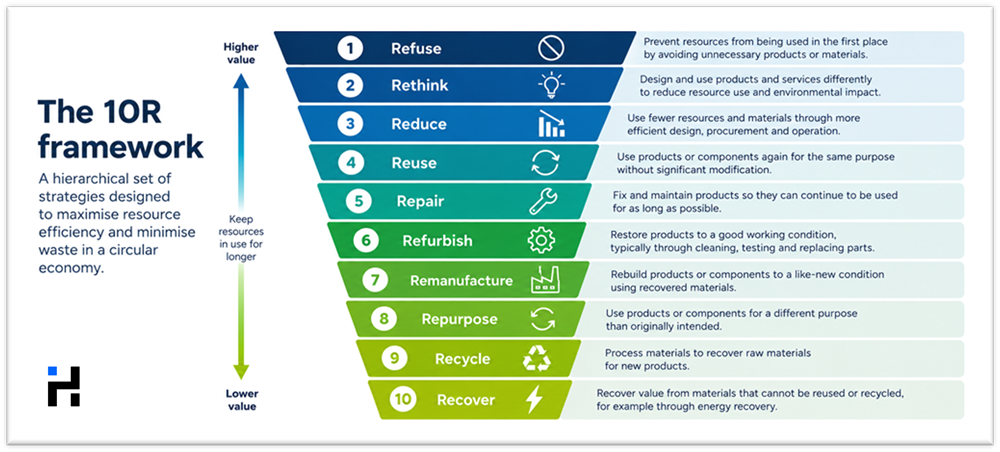
The distinction is important: RFID can help make assets visible, but organisations still need reliable data and informed processes to decide what should happen to them next. The research discusses the 9R framework. The infographic below presents a related 10R formulation, which also includes 10 Recover.
Circularity starts with knowing what you have
An organisation cannot make an informed decision about reusing or redeploying an asset if it cannot confidently establish what the asset is, where it is located and whether its records reflect reality.
Asset information can become outdated as equipment moves between sites, changes hands, undergoes maintenance or falls out of use. An asset register that does not reflect these changes can make it difficult to distinguish between equipment that is genuinely surplus, equipment that remains operationally necessary and equipment that requires attention.
Before purchasing additional equipment, an organisation can check its asset register to identify existing assets that are available, suitable and fit for purpose. This may reveal opportunities for redeployment or confirm that new equipment is needed.
Similarly, equipment that cannot be located or confidently identified may be treated as unavailable, even when it remains serviceable.
Accurate asset information helps establish the baseline for better decisions. It enables organisations to understand what they have before determining what they need to acquire, maintain, transfer or retire.
This is why Enterprise Asset Management is relevant to the circular-economy conversation. Managing assets across their lifecycle provides a structured way to connect asset records with maintenance, inventory, audits, accountability and reporting.
A practical framework for turning asset data into action
The value of asset identification increases when the information captured can be used to support practical decisions.
- Identify: Establish which asset is being considered using its unique identifier and existing records.
- Verify: Confirm its location, condition, ownership and record accuracy.
- Assess: Review maintenance history, utilisation, suitability, safety and operational needs.
- Decide: Determine whether repair, reuse, redeployment, refurbishment, replacement or retirement is most appropriate.
- Record: Document the action taken and update the asset record so future decisions have a reliable history.
Maintain and Repair
Reliable condition information and maintenance history help organisations assess whether an asset can continue operating safely and effectively. Repair may be appropriate when an asset remains fit for purpose, while replacement may be justified when reliability, safety, performance or lifecycle costs no longer support continued use.
Reuse and Redeploy
An asset that is surplus to one team’s requirements may still be useful elsewhere. Verified location, condition and utilisation data can help identify potential transfers before additional equipment is purchased. Suitability can then be confirmed against the receiving team’s operational needs.
Replace and Retire Responsibly
Not every asset should remain in service indefinitely. Accurate lifecycle records help organisations make informed replacement and retirement decisions, maintain traceability and document final disposition, supporting responsible and accountable disposal.
Why asset verification matters
Asset records are only useful when they reflect the assets an organisation actually manages. Physical verification helps identify discrepancies between the register and reality — including missing assets, incorrect locations, outdated details and equipment whose condition or status needs to be reviewed.
Regular audits can help establish a more reliable baseline for lifecycle decisions. They may also reveal assets that warrant further investigation before an organisation commits to purchasing replacements or disposing of existing equipment.
Hardcat’s Asset Audit Solutions support asset identification, field data capture and reconciliation of physical assets against existing database records.
Verification does not make every asset decision for the organisation. It provides better evidence on which to base the decision.
Close the loop: record the decision and outcome
Asset information can quickly lose its value when changes identified in the field are not reflected in the organisation’s central records.
A technician may identify equipment requiring repair. An audit team may confirm that an asset has moved. A site manager may determine that an item is no longer required at its current location. If these findings are not translated into updated records and appropriate actions, subsequent decisions may rely on outdated information.
Mobile Asset Management can support field-based identification, data capture and record updates. Hardcat’s Mobility Solutions support these activities using mobile devices, including barcode and RFID scanning.
The important step is closing the loop: capture the information, assess what it means, record the decision and update the asset’s status.
This is the same principle explored in Your Asset Data Is Only Valuable If You Can Act on It. Collecting asset information is only the starting point. Its value comes from using it to inform decisions and take action.
What sustainable asset management looks like in practice
Circular-economy principles become tangible when organisations can identify assets and equipment that may still have value, establish their condition and find practical alternatives to disposal. In the built environment, this can mean giving furniture, fixtures, fittings and construction materials a second life rather than sending them to landfill.
Hardcat’s collaboration with FTD Circular demonstrates how asset registers, digital tagging and structured asset information can support these activities.
For a broader look at how asset visibility, lifecycle management and data-driven maintenance can support sustainability objectives, read Hardcat’s Sustainable Asset Management article.
Stockland: Diverting Retail De-fit Materials From Landfill
In 2023, FTD Circular collaborated with Stockland (one of Australia’s largest diversified property groups) on a retail de-fit project designed to maximise the recovery and reuse of furniture, fixtures, fittings and other materials.
FTD Circular created the data for the Hardcat asset register, tagged assets and used the FTD Circular/Hardcat asset management platform to support site management and match items with appropriate circular-economy pathways.
The project diverted 170 assets from landfill for commercial or charitable reuse, including donations to Crown St Public School. One donation match was estimated to avoid more than 4.6 tonnes of embodied carbon.
The project reported 100% diversion from landfill for furnishings, fixtures and fittings, alongside 87% diversion of construction materials through reuse, sale, donation and recycling.
This example demonstrates the practical value of identifying items, recording their details and making that information available to support reuse and recovery decisions. With reliable asset information and appropriate coordination, organisations can identify materials with potential for a second life rather than sending them directly to landfill.
City of Casey: Applying Circularity To Community Facilities
FTD Circular also worked with the City of Casey (a local government area located in the outer south-eastern suburbs of Melbourne, Victoria, Australia) on a pilot to apply circular-economy practices when de-fitting community facilities, using Hardcat’s asset management digital platform.
Through reuse, donation and recycling, the pilot diverted 90% of fixtures and fittings from landfill, according to the published case study.
Following the pilot, FTD Circular was engaged to advise on embedding circular-economy principles into Council’s environmental sustainability and development, procurement and disposal policies.
This example highlights an important consideration: circularity is not just a matter of finding somewhere else for unwanted items to go. It also involves establishing processes that consider reuse and recovery when assets and materials are managed, procured and disposed of.
The Role Of Trusted Asset Data
These examples show how structured asset information can help organisations identify items for reuse, donation, refurbishment or recycling. Achieving these outcomes also requires suitable recipients, service providers and processes to coordinate what happens next.
Turning asset information into better lifecycle decisions
Circular-economy decisions depend on reliable asset information, informed assessment and a clear record of the action taken. Hardcat Lebosi Enterprise Asset Management helps organisations bring asset information and lifecycle activities together to strengthen visibility, accountability and control.
This approach helps create a more defensible basis for decisions about maintenance, reuse, redeployment, replacement and retirement.
Organisations looking to connect asset lifecycle management with their broader environmental objectives can also explore Hardcat’s Sustainability and the Environment solution.
Looking to improve asset visibility and make better-informed lifecycle decisions?
Talk to Hardcat about how your organisation manages asset records, verification, maintenance and lifecycle information, and how better visibility could support your operational and sustainability objectives.