The circular economy in built environments aims to repurpose furniture, whitegoods, and other items to extend their lifespan, reduce waste, and minimise the demand for new raw materials. By reusing, refurbishing, and recycling resources within buildings and workplaces, organisations can cut down on landfill contributions, lower costs, and support sustainable growth. This approach not only benefits the environment but also creates opportunities for innovation in design, construction, and asset management practices.
Core Principles
The circular economy emphasises reusing, refurbishing, and recycling materials like furniture and whitegoods to extend lifespans, cut waste, and reduce virgin raw material demand, directly as stated. This applies to buildings and workplaces through strategies like material recovery and designing for disassembly.
Environmental and Cost Benefits
Reusing resources lowers landfill use, embodied carbon emissions (potentially by 75% by 2050 versus new builds), and operational costs while enhancing supply chain resilience. Organizations gain from reduced material expenses and compliance with sustainability regulations.
Innovation Opportunities
Circular practices drive advancements in modular design, asset tracking for reuse, and construction methods, fostering sustainable growth across sectors. This creates economic value, such as $600 billion in recirculated retrofit materials by 2050.
What is a de-fit or strip-out?
A building strip-out, also known as a de-fit (de-fittings), is the process of removing all internal fixtures, fittings, and alterations from a property, leaving it as a “bare shell”. This service is performed to prepare a space for renovations or to return a commercial space to its original condition at the end of a lease.
Most of these items are sent to landfill, but we aim to repurpose items via a materials bank created by FTD Circular (FTDC) using Hardcat software technology. The Built Environment Circular Economy Supplier Directory is intended to complement sustainable product databases, such as GreenTag and GECA. Scroll down to explore case study partnerships showcasing real-world applications.
Adopting circular economy principles
Adopting circular economy principles in lifecycle management and fit-out design, construction, and de-fit means rethinking asset design, use, and management. It involves strategies like:
- Repairing and maintaining assets to extend their life.
- Refurbishing and remanufacturing them when possible.
- Repurposing or redistributing assets that have outlived their use.
By prioritising recovery and recycling, organisations can cut waste and reliance on new raw materials. This shift to a circular model supports sustainability. It saves money and boosts resilience. Positioning your organisations for success in a resource-limited world.
What is the role of asset management in the circular economy?
The circular economy is a major step toward sustainability and regeneration, aiming to protect and restore natural and social capital. It achieves this by optimising resource use, reducing waste, and extending asset lifecycles through interconnected systems.
In asset management, organisations can extend asset life, design for multiple refurbishments, shift to service-based models, and form partnerships for sustainability. Because adopting circular economy principles benefits both the environment and economic resilience.
These strategies align with global climate goals. Asset management plays a key role in reducing climate impact, solving supply chain issues, and driving regeneration through circular practices. Recognising its role in sustainability enables industries, governments, and municipalities to cut carbon footprints and optimise resources.
Traditional asset management follows a linear path of acquisition, use, and disposal, often discarding assets due to cost and convenience. This contradicts sustainability efforts focused on conserving resources, reducing carbon emissions, and minimising waste.
By shifting from a take-make-dispose model to a circular approach, asset managers can lead sustainability efforts. Implementing circular economy principles helps organisations tackle environmental challenges, cut emissions, and enhance long-term financial stability.
In a circular economy, assets no longer have a fixed ‘end-of-life.’ This mindset drives innovation in product design, efficiency, and service models. New business strategies, partnerships, and practices like reduction, reuse, remanufacturing, and repurposing emerge. A closed-loop approach reduces resource depletion and waste, supporting a more resilient global economy.
Key concepts of circular economy in asset management

Prolonged Asset Life
Maximise assets’ useful life through maintenance, repair, and refurbishment. Ensuring assets remain operational for as long as possible before they reach the end of their life.
Reuse and Refurbishment
Organisations can refurbish or repurpose old assets instead of discarding them. This also applies to building strip-outs (de-fits) This gives them a new lease on life. For example, someone might refurbish and redeploy used equipment instead of scrapping it.
Resource Recovery
At an asset’s end, we can recycle its components. This creates new products and reduces the need for virgin materials. This helps in conserving resources and minimising environmental impact.
Efficient Asset Use
Digital asset management tools and IoT solutions can optimise asset use. Ensuring assets are used efficiently and preventing waste from underutilisation.
Benefits of circular economy principles for asset management
Applying circular economy principles in asset tracking ensures that your assets are used to their full potential, reducing both environmental impact and costs associated with the procurement of new equipment. It aligns with sustainability goals while promoting operational efficiency.
Cost Savings: By prolonging the life of assets and reducing the need to purchase new equipment, organisations can save significantly on costs.
Environmental Sustainability: A circular economy reduces waste and lowers carbon emissions by recycling materials and reducing the extraction of raw resources.
Enhanced Resilience: By relying less on new resource inputs and more on existing resources, organisations can become more resilient to supply chain disruptions.
Five Ways That ESG Creates Value: Getting your environmental, social, and governance (ESG) proposition right links to higher value creation. Your business, like every business, is deeply intertwined with environmental, social, and governance (ESG) concerns. It makes sense, therefore, that a strong ESG proposition can create value. A strong environmental, social, and governance (ESG) proposition links to value creation in five essential ways:
- Top Line Growth: Attract B2B and B2C customers with more sustainable products. Achieve better access to resources through stronger community and government relations.
- Cost Reductions: Lower energy consumption and reduce water intake.
- Regulatory and Legal Interventions: Achieve greater strategic freedom through deregulation. Earn subsidies and government support.
- Productivity Uplift: Boost employee motivation. Attract talent through greater social credibility.
- Investment and Asset Optimisation: Enhance investment returns by better allocating capital for the long term (e.g., more sustainable plant and equipment).
Avoid investments that may not pay off because of longer-term environmental issues. Getting your environmental, social, and governance (ESG) proposition right links to higher value creation.
ISO 59004:2024 and the circular economy
ISO, the International Organisation for Standardisation, brings global experts together to agree on the best way of doing things. Experts from around the world have agreed on ISO standards, and they have the following to say about asset management and the circular economy:
The global economy is “linear,” as it is mainly based on extraction, production, use, and disposal. This linear economy leads to resource depletion, biodiversity loss, waste, and harmful losses and releases, all of which collectively are causing serious damage to the capacity of the planet to continue to provide for the needs of future generations.
Moreover, several planetary boundaries have already been reached or exceeded. There is an increased understanding that a transition towards an economy that is more circular, based on a circular use of resources, can contribute to meeting current and future human needs (welfare, housing, nutrition, healthcare, mobility, etc.).
Transitioning towards a circular economy can also contribute to the creation and sharing of more value within society and interested parties, while natural resources are managed to be replenished and renewed in a sustainable way, securing the quality and resilience of ecosystems.
Organisations recognise many potential reasons to engage in a circular economy (e.g., delivering more ambitious and sustainable solutions; improved relationships with interested parties; more effective and efficient ways to fulfil voluntary commitments or legal requirements; engaging in climate change mitigation or adaptation; managing resource scarcity risks; increasing resilience in the environmental, social, and economic systems), while contributing to satisfying human needs. ISO 59004:2024(en) Circular economy — Vocabulary, principles and guidance for implementation
FTDC and Hardcat collaboration case studies
Stockland Retail De-fit
How Stockland achieved 100% waste-to-diversion of loose items
In 2023, FTDC collaborated with Stockland (one of Australia’s largest diversified property groups) to implement a circular economy approach for a retail de-fits project, setting a new standard for waste diversion from landfills.
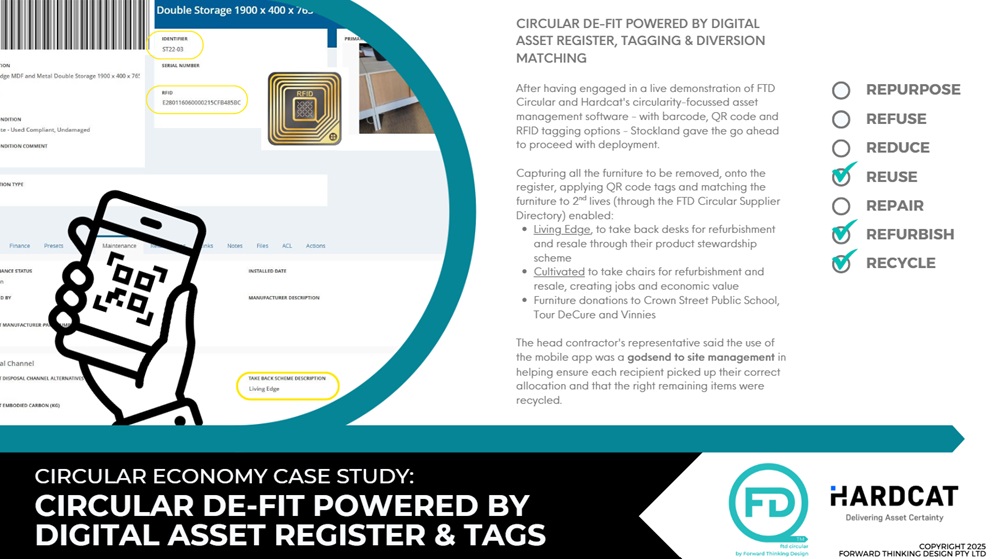
FTD Circular created the data for the Hardcat asset register, tagged the assets, and facilitated the site management improvements using the FTD Circular/Hardcat asset management platform. The >90% landfill diversion was achieved with logistics from Living Edge, Cultivated, Office Spectrum and ALD.
Over 90% of furniture and materials, by weight, successfully diverted from landfill. 170 assets diverted from landfill to commercial and charitable reuse including to Crown St Public School. One donation match alone saved >4.6 tonnes of embodied carbon in otherwise new procurement.
- 100% of furnishings, fixtures & fittings diverted from landfill.
- Social impact value of >$40,000.
- 100% waste-to-diversion of loose items and 87% of construction materials by reusing, selling, donating, and recycling.
“I found FTD Circular’s circular economy processes, tools and visions to be robust and well-thought out to be practical in execution. FTD Circular executed their project to a high standard and in a very timely fashion.” Matthew Gusti, New Initiatives Manager, Innovation, Marketing & Technology – Stockland.
FTD Circular was also engaged by Stockland to develop a materials and furnishings bank (Hardcat asset and inventory register with digital tagging) for three levels of one of their office properties in Sydney. Our activities enabled efficient site management by the head contractor, and we maximised landfill diversion by matching de-fit items to circular economy solutions, including reuse, refurbishment, donation and recycling.
City of Casey De-Fit Pilots
De-fitting community facilities
City of Casey awarded FTDC a grant to pilot FTDC’s circular economy approach (and Hardcat’s asset management digital platform) to de-fit community facilities. Through reuse, donation and recycling, 90% of all fixtures and fittings were diverted from landfill. Since this successful pilot, FTD Circular has been engaged to consult on embedding circularity into Council’s ESD, procurement and disposal policies.
“The experience (was) a real awakening for us regarding the potential of using products (from) a material bank to enable a circular economy… (FTD Circular offers) a future where (we) could tap into a comprehensive digital catalogue of existing materials and products for use in new… projects.” Brad Manser, Ian McEwan Designs Pty Ltd Architects.

FTD Circular’s Suppliers Directory – find suppliers, reduce waste, create impact
The Built Environment Circular Economy Supplier Directory (powered by Hardcat technology) is a free, public resource designed to connect businesses with suppliers driving circular economy solutions in Australia’s built environment. From sustainable procurement to waste-to-landfill diversion, our directory features over 1,000 verified organisations committed to reusing, repairing, reselling, donating, remanufacturing, and recycling materials—helping you reduce embodied carbon and achieve sustainability targets.
Complementing certifications and other databases like Global GreenTag, GECA, Social Traders, and B Corporation, we spotlight local leaders integral to the circular economy ecosystem. This Directory is intended to complement existing sustainable product databases not replace them, but this Directory differs as follows:
- We have screened listings by organisation, not by product, because adopting a circular economy approach is a whole of business concern. These organisations aren’t perfect but they are on their way and are more advanced than industry average.
- A focus on recycled content or creating recyclable or down-cyclable products alone isn’t enough. These organisations tick multiple circular economy boxes.
We believe that innovative small start-ups, social enterprises, donation platforms, repair cafes and second-hand stores should be elevated to form an integral part of the built environment design/construct/de-fit eco-system. You will find that the Directory includes both these ‘local legends’ and the large companies who can afford to apply for ISO and Green certifications.
Material Bank Whitepaper
FTDC’s Material Bank case study and whitepaper explores the benefits and barriers experienced in creating fitout material banks – a collaboration with commercial construction management firm, Project One.

Hardcat solutions play a pivotal role in enabling circular economy principles in fitout design, construction, and de-fit. Supporting your organisation’s sustainability goals and helping to create lasting value.